

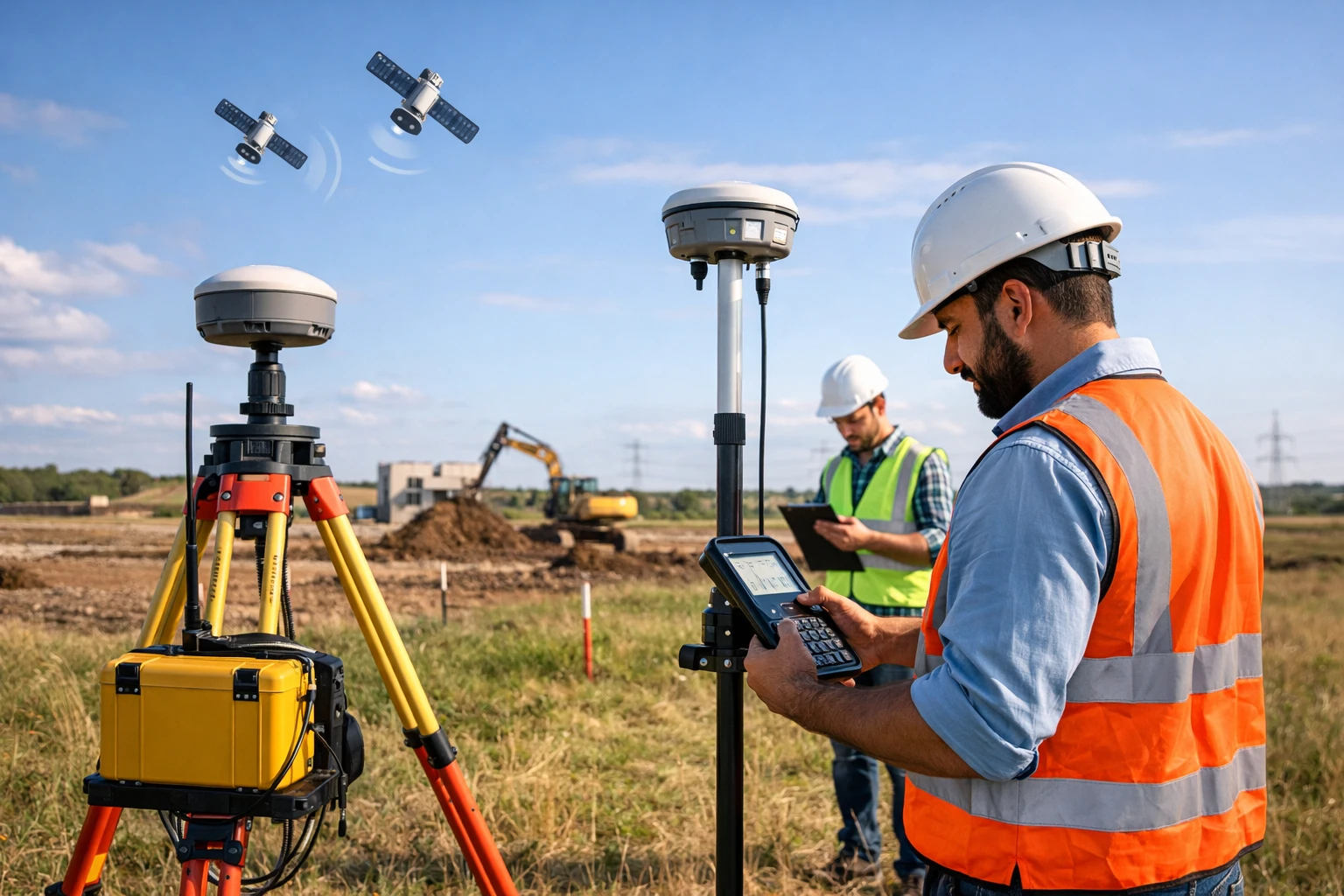
DGPS Survey: Meaning (In Simple Words)
A DGPS (Differential GPS) survey is a positioning method that improves ordinary GPS results by using correction data from a known reference point (a “base station”) to reduce common satellite and receiver errors. In the best setups, DGPS techniques can improve accuracy dramatically compared to basic GPS.
Think of normal GPS like asking for directions in a crowded market—helpful, but a little messy. DGPS is like having a local guide who says, “GPS is slightly off today; shift your position this much.” That correction is what makes the survey usable for boundaries, engineering layout, and high-stakes mapping.
Featured-snippet definition
DGPS survey = GPS positioning + real-time (or post-processed) correction from a reference station, producing much better accuracy than standalone GPS.
A Real-Life Story: Why “Close Enough” Can Become Expensive
Imagine a developer buying land for a small industrial shed. The documents show the boundary is “about here,” and a basic GPS check looks fine.
Then construction starts.
A neighbor files an objection: the foundation is 0.8–1.2 meters inside their plot (yes, this happens). Now you’re stuck in delays, rework, and legal headaches—often costing far more than the survey would have.
This is exactly where DGPS (and often RTK, which is a high-precision form of DGPS) becomes a business decision, not just a technical choice. Parivesh+1
DGPS vs GPS vs RTK: What’s the Difference?
Standalone GPS (what your phone uses)
-
Good for navigation
-
Not reliable enough for property boundaries or engineering setting-out
DGPS (differential corrections)
-
Uses a reference station correction
-
Often reaches sub-meter accuracy (and better in strong setups), depending on method and conditions
RTK (Real-Time Kinematic) — a popular “survey-grade DGPS” approach
RTK uses carrier-phase measurements and real-time corrections to reach centimeter-level positioning in many field conditions.
A practical way to remember it:
-
GPS = “Where am I roughly?”
-
DGPS = “Where am I accurately?”
-
RTK = “Where am I accurately enough to build and mark boundaries?”
How DGPS Works (No Jargon, Just the Logic)
A DGPS survey typically uses:
-
Base station placed on a known coordinate (or tied to a known control point)
-
Rover receiver that moves across your site to collect points
-
Corrections sent to the rover (radio/cellular/network) or applied later in post-processing
The base compares:
-
its known, true position
-
vs its GPS-calculated position
…and computes the difference. That difference becomes the correction applied to the rover.
DGPS Accuracy: What You Can Realistically Expect
Accuracy depends on:
-
equipment (single vs dual/multi-frequency GNSS)
-
correction type (DGPS vs RTK vs PPK)
-
distance from base station
-
sky visibility (trees/buildings)
-
multipath (signal bouncing off structures)
-
time of day / satellite geometry
Common accuracy ranges (field-friendly)
-
Standalone GPS: typically meters-level (fine for navigation, not for boundaries)
-
Traditional DGPS: can improve to sub-meter in many real-world setups
-
RTK (a precise DGPS method): often centimeter-level; many systems express it like:
-
Horizontal ≈ 0.6 cm + 0.5 ppm × distance
-
Vertical ≈ 1.0 cm + 1.0 ppm × distance
-
That “ppm × distance” part matters:
-
If your rover is 10 km from the base, small errors stack up, so accuracy typically gets worse with longer baseline distances.
Horizontal vs vertical accuracy (important!)
Most people focus only on “position,” but elevation (Z) is harder. A useful rule of thumb from GNSS support guidance: vertical accuracy is often worse than horizontal, sometimes around ~1.7× in typical observations.
So if you need drainage design, earthwork, or road profiles, ask specifically about:
-
expected vertical accuracy
-
control points and leveling checks
-
how contours/DTM were validated
What Impacts DGPS Accuracy the Most?
1) Sky visibility
Open sky = best. Under trees or near tall buildings = signals get weak and reflect.
2) Multipath (reflections)
In dense urban areas, the rover may “see” reflected signals from metal sheds, walls, or glass facades, increasing noise.
3) Correction quality
A stable base station (or reliable network RTK) matters more than people think.
4) Baseline distance (base ↔ rover)
Longer distance = more atmospheric differences between base and rover = more error.
5) Survey method and discipline
Even great equipment fails with poor field practice. Good teams do:
-
repeated observations
-
control checks
-
clear field notes + metadata
-
consistent coordinate system + projection
DGPS Survey Cost: What It Typically Includes
DGPS survey pricing is not “one fixed number,” because cost depends on:
-
land size (acres/hectares)
-
terrain (plain vs hilly)
-
vegetation and accessibility
-
deliverables (just boundary points vs full topo + contours + CAD/GIS)
-
urgency (normal vs fast-track)
-
control requirements (new control points, benchmarks, verification)
What you’re paying for (beyond the device)
-
field team time (setup + observation + checks)
-
control and validation points
-
data processing and QA
-
outputs: CAD, GIS files, KML, coordinate lists, maps, reports
DGPS Survey Cost in India: Practical Ranges (With Examples)
Because rates vary city-to-city and by scope, it’s safer to think in price bands rather than a single number.
Here are real market-style quote patterns you may see in India:
-
Lumpsum for smaller parcels (example quote patterns show amounts like ~₹95,000 for 1–10 acres in some listings)
-
Per-acre pricing for larger areas (example quote patterns show around ₹2,000/acre for certain large-area brackets in some listings)
-
Some vendors quote by manpower/day (example listing shows figures like ₹20,000 per person as a price-style reference)
Example 1: 8-acre boundary + basic mapping
-
If a provider uses a small-plot lumpsum model, the quote may be closer to a fixed amount rather than per-acre.
-
Cost rises if you need legal boundary reconciliation + markings + documentation.
Example 2: 200-acre solar site (topo + contours + cut/fill inputs)
Using a per-acre quote style (illustrative market pattern):
-
200 acres × ₹2,000/acre = ₹4,00,000 (scope-dependent)
Add-ons that can increase cost: -
higher density spot levels / tighter contour interval
-
more GCPs and control points
-
faster turnaround
-
dense vegetation / difficult access
Important: Treat these as reference patterns, not universal pricing. The most accurate “cost” is a written scope-based quote.
When You Need a DGPS Survey (And When You Don’t)
You likely need DGPS (or RTK) when…
Boundary marking and demarcation
If ownership lines matter, “approximate GPS” is risky. DGPS helps create defendable coordinates and boundary pillars.
Cadastral and revenue-linked work
When your project must match land records, plot boundaries, and legal maps, you need a more rigorous approach than navigation-grade GPS.
Topographic surveys and contour mapping for planning
Roads, drainage, layouts, and earthwork estimation need consistent coordinates and reliable elevation workflows.
Construction layout / setting-out
Columns, road centerlines, utility corridors, pile locations—small errors become structural problems later.
Infrastructure corridors
Pipelines, canals, highways, transmission routes—DGPS/RTK is widely used because alignments and chainages must be consistent across long distances.
Renewable energy projects
Solar and wind projects commonly need:
-
precise boundary marking
-
terrain suitability (slope/elevation models)
-
turbine/grid coordinate marking
-
documentation support for approvals
DGPS may be overkill when…
-
You just need a rough location for navigation
-
The site decision is early-stage and not tied to legal boundaries
-
You’re doing a quick reconnaissance before a full survey
In those cases, a basic GPS/handheld approach may be enough for the moment—just don’t treat it as a final survey.
DGPS Survey Process: Step-by-Step (What Happens on Site)
1) Requirement discussion (scope and deliverables)
Good survey teams ask:
-
Do you need boundary only, or boundary + topo + contours?
-
Which coordinate system is required?
-
What output format do you want (CAD, GIS, KML, report)?
2) Reconnaissance and control planning
They check:
-
sky visibility
-
obstacles (trees, buildings)
-
where control points/benchmarks should be
3) Base station setup + rover observations
-
Base is established and stabilized
-
Rover collects boundary points / spot levels / features
4) Quality checks in the field
Professionals re-check critical points, repeat observations, and validate closure.
5) Processing, corrections, and reporting
-
corrections applied
-
coordinate list prepared
-
maps and drawings created
-
deliverables packaged
Deliverables You Should Ask For (So the Survey Is Actually Useful)
Depending on scope, request:
-
Coordinate list (with point IDs and descriptions)
-
KML/Google Earth file (easy visual verification)
-
CAD drawing (DWG/DXF)
-
GIS layers (SHP/GeoJSON if needed)
-
Topographic map
-
Contour map (mention contour interval)
-
Survey report (method, equipment class, date/time, accuracy notes)
If your work is legal-sensitive (boundary disputes, acquisitions), also request:
-
control point details
-
observation notes (summary)
-
coordinate system/projection clearly stated
Expert Insights: How to Judge a “Good” DGPS Survey Provider
A strong provider doesn’t just say “DGPS done.” They explain:
-
what correction method they used (DGPS/RTK/PPK)
-
how they handled control
-
what accuracy class is realistic for your site conditions
-
what checks were performed
Questions that separate pros from “just operators”
-
How do you validate boundary points on the ground?
-
How many control points will you establish and why?
-
What’s the expected horizontal and vertical accuracy for this terrain?
-
What deliverables will I receive, and in what coordinate system?
-
How do you handle areas with tree cover or poor satellite visibility?
(If a provider promises “1 cm everywhere always,” be cautious. Accuracy depends on baseline, sky visibility, and workflow discipline. pointonenav.com+1)
DGPS vs Total Station: Which One Should You Choose?
This is a common question, and the best answer is: often both.
DGPS/RTK shines when:
-
you need fast coverage over large areas
-
coordinates must tie to global/state reference systems
-
you’re mapping corridors or big land parcels
Total station shines when:
-
you need high precision in obstructed areas (buildings/trees)
-
line-of-sight measurement is feasible and controlled
-
you’re doing tight construction layout around structures
In many real projects:
-
DGPS establishes primary control
-
total station handles fine detailing and layout in difficult zones
DGPS Survey FAQs (Built for Featured Snippets)
How accurate is a DGPS survey?
It depends on method and conditions. Traditional DGPS can reach sub-meter accuracy, while RTK (a precise differential GNSS method) often reaches centimeter-level accuracy under good conditions.
What is the difference between DGPS and RTK?
RTK is a high-precision form of differential GNSS positioning that uses carrier-phase measurements and real-time corrections, commonly delivering much tighter accuracy than basic DGPS setups.
How much does a DGPS survey cost in India?
Costs vary widely by scope, land size, terrain, and deliverables. Market listings show both lumpsum and per-acre patterns (for example, some quotes show around ₹2,000/acre for certain large-area brackets), but final pricing should be based on your exact scope.
When should I choose DGPS for my project?
Choose DGPS/RTK when boundaries, engineering alignment, topo/contour planning, or approvals require reliable coordinates and repeatable accuracy.
Why is elevation accuracy usually worse than horizontal accuracy?
GNSS geometry and signal behavior make vertical positioning more sensitive; practical guidance often notes vertical accuracy tends to be worse than horizontal in typical GNSS usage.
A Simple Checklist Before You Book a DGPS Survey
-
Confirm your purpose: boundary / topo / contours / layout / as-built
-
Ask what correction method will be used (DGPS vs RTK vs PPK)
-
Ensure coordinate system/projection will be stated clearly
-
Request sample deliverables (CAD/GIS/report format)
-
Ask about QA checks and control points
-
Clarify timeline, site access requirements, and marking method (pegs/pillars)
Final Takeaway: DGPS Is “Decision Insurance”
A DGPS survey is not just about coordinates—it’s about reducing risk:
-
fewer disputes
-
better planning
-
smoother approvals
-
more accurate execution
-
less rework
If your project involves ownership boundaries, construction, infrastructure alignment, renewable layouts, or earthwork planning, DGPS/RTK is often the safest foundation you can buy.
Community Feedback